What makes this project interesting is that Google Ads campaigns run in parallel with the Meta campaigns, so some of the sales reported in the Meta ad account may actually be attributable mostly to Google Ads. To make sense of this, we'll explain what attribution models are and how to analyze results in Meta when other traffic sources are running in parallel.
Before and after
To compare results before and after, let's take the first three months of the collaboration and compare them with the most recent three months.
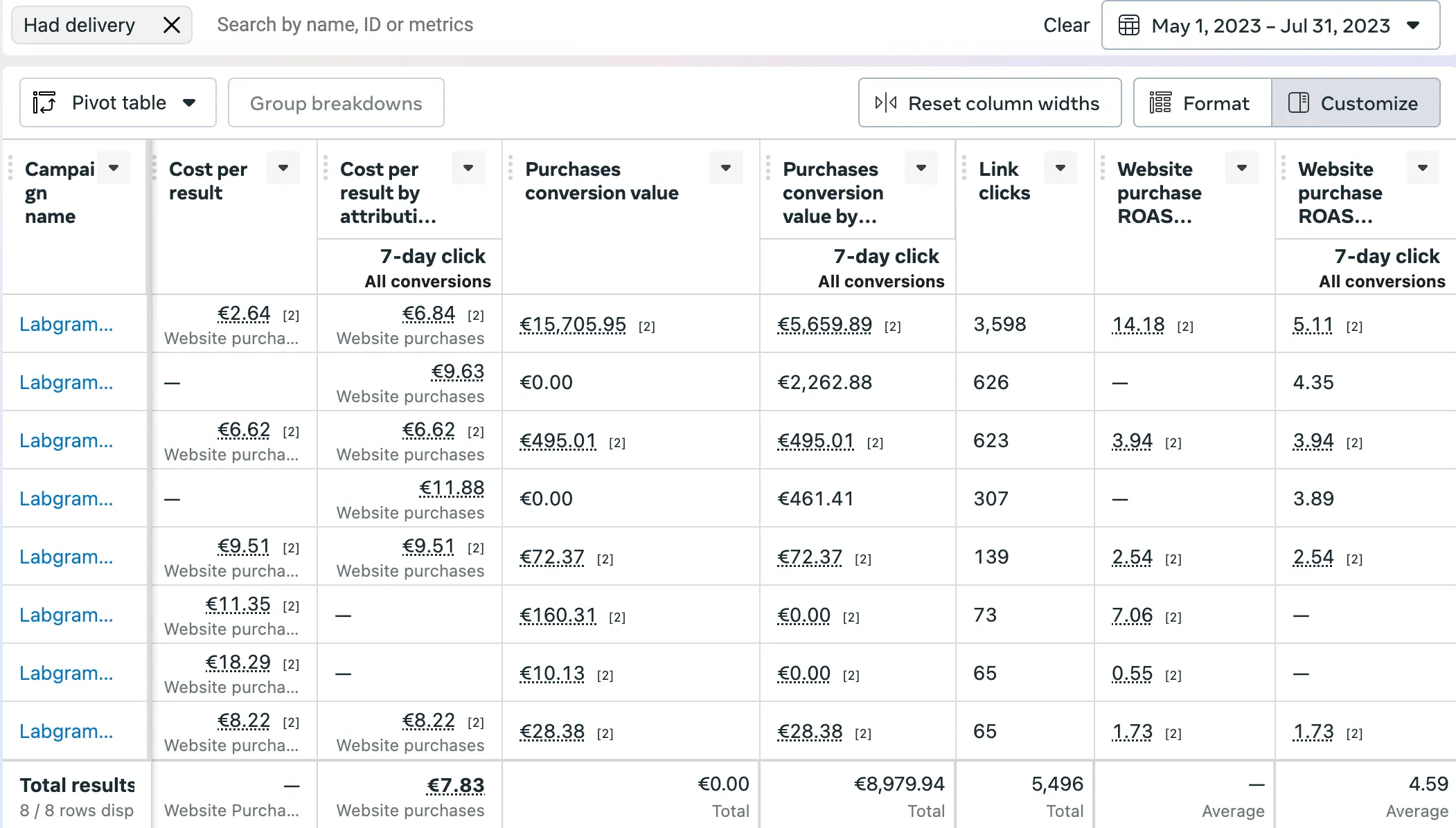
The first three months of the collaboration, starting May 2023:
- ROAS 840%
- Budget €1,957
- Revenue €16,470
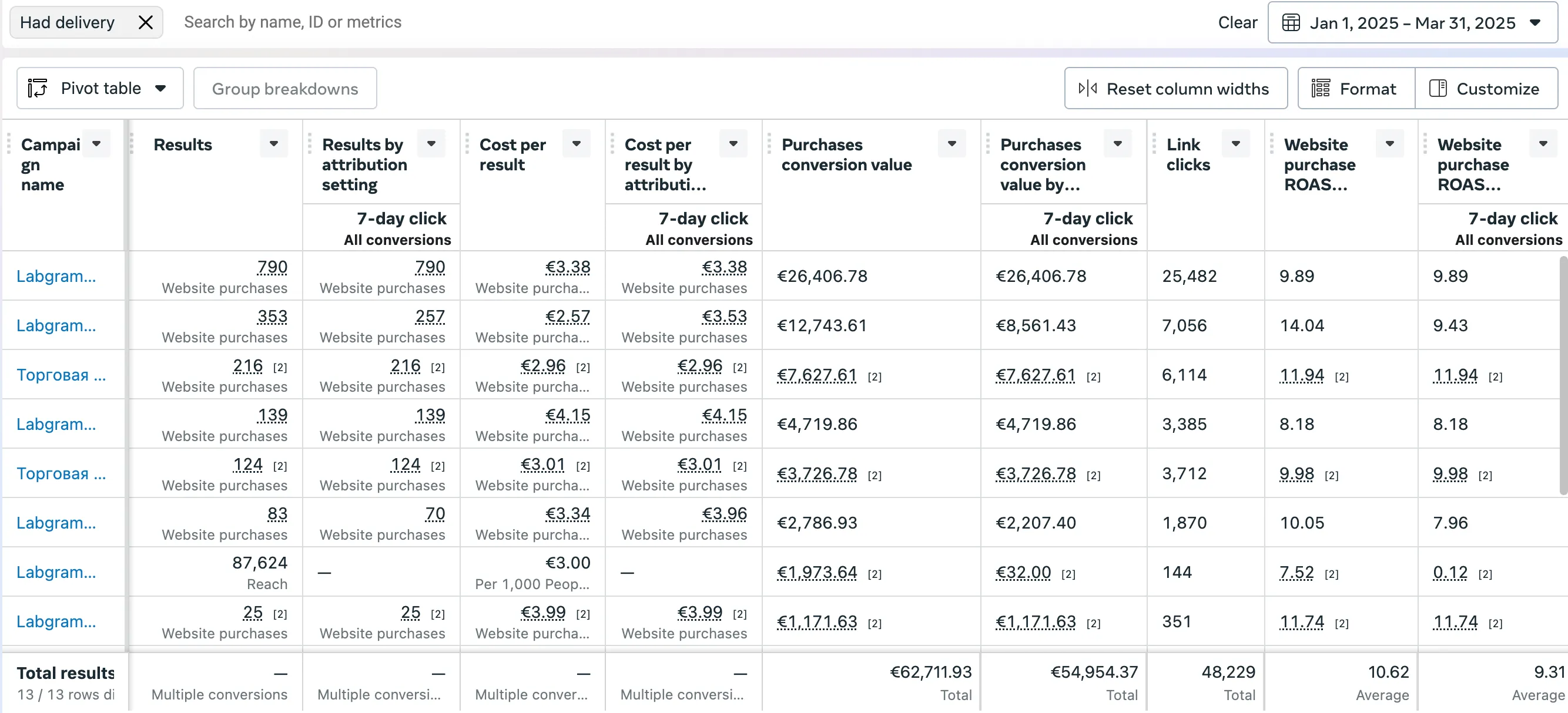
Results of the most recent three months (as of 31.03.2025):
- ROAS 1062%
- Budget €5,905
- Revenue €62,711
Why you shouldn't evaluate results only in the Meta ad account — and what attribution models have to do with it
The Meta ad account can receive conversions generated by other traffic sources. How does this work? First, a person sees an ad on Meta — the system records that the user saw the ad, meaning Meta had an influence on them. Then this user goes to Google, makes a search, sees a Google ad, clicks it and buys the product on the website. Information about the purchase will be sent to the Google Ads account and also to the Meta Ads account. So if you add up the results of both systems, you'll see 2 conversions and the revenue of two purchases. But in fact, there was only one conversion.
This happens because of attribution models. These models tell us how and under what conditions the system records a conversion, and how much value to assign to each traffic source. Value in this case is the revenue from the conversion.
Going back to the situation described above, we know that the person first saw the ad on Meta. That impression may well have stimulated demand for the product — we may have planted the idea of the product, and the person later decided to search for it on Google. So in such situations, with standard ad settings, Meta records the conversion because the person simply saw the ad. This attribution model in Meta is called “7-day click and 1-day view,” which means: “I will record all conversions that happen within 7 days after an ad click and 1 day after an ad view.” Anything outside this window won't be recorded in the results.
This raises the question of whether it makes sense to record conversions that happened after viewing an ad without clicking it. It does make sense, because impressions have an influence, but you need to understand exactly who those impressions are being served to. If they're regular customers, it's better to exclude them from impressions and move them into a retargeting audience.
As an alternative approach, you can optimize using 7-day click attribution, without counting views. Then all conversions will be shown only after a click, and all optimization will target users who are most likely to click.
Let's look at what the statistics look like with the alternative attribution model.
Results with the alternative attribution model
Note the columns marked 7-day click — this is the alternative attribution that doesn't count post-view conversions. We can see how much lower revenue and ROAS are under this attribution. This gives us a better understanding of Meta's influence on user conversion; after all, a click is a higher-quality interaction with an ad than viewing it without clicking.
When several traffic sources work together, it's crucial to understand their impact on user conversion. To do this, you should compare different attribution models with each other and make budget allocation decisions across channels based on that comparison.